Monday, 7 November 2016

Miswak or Meswak tree


This straggling tree or a large shrub is very resistant to saline conditions; where many other plants cannot survive. It can be found growing on banks of creeks and also near other water bodies which are not saline. This tree is native to many countries, including India. The widespread growth of this plant around the wold may be due to migratory birds. Many birds relish fruits of Miswak. Many migratory birds flock near water bodies and through their droppings these plants may have been finding root in several countries around the world.
Salvadora persica tree

Salvadora persica tree

Salvadora persica flowers and fruit

Salvadora persica flowers and fruit

Miswak is traditionally used for dental care. Pieces of stems, about pencil thick are cut and used like a toothbrush. By chewing one end of the stick, fibers of the stick get separated like a brush. Our synthetic toothbrushes need to be used with toothpaste, as they do not have any germicidal properties. Miswak has germicidal, antibacterial and some other medicinal uses. Thus use of toothpaste is not needed. In many Arabic countries Miswak is being used as toothbrush from historic period.


https://en.wikipedia.org/wiki/Miswak#/media/File:Miswak2.jpg)

Though Miswak is generally found near water bodies, it is quite drought resistant. Due to its tenacity to resist the drought, Miswak can be found in many deserts also.

Cistanche tubulosa is root parasite and gets its water and nutrients from its host, which is normally Miswak tree. I had photographed Cistanche tubulosa in desert of Pokhran in Rajasthan, India.


Cistanche tubulosa
Its scientific name is Salvadora persica. It is also known by other common names – Toothbrush tree, Mustard tree (due to its pungent taste like that of Mustard) and खारा पिलू, खाखन

Saturday, 8 October 2016

Wonderful roots

Roots of plants play many functions in survival of a plant. Matured roots support the plant. Root hair absorbs water and water soluble minerals from the medium in which they grow. All living roots of a plant also respire; and that is why most plants need friable planting mixture, which allows aeration near the root zone. It is very interesting to know how roots of different plants get modified to survive in adverse conditions.


Adventitious roots: Some climbers like money plant and Betel leaf cling to support with 'Adventitious roots'. Unlike roots in soil, they grow on stems and cling to support for climbing up. Though their primary task is clinging to support, they are capable of absorbing moisture and water soluble minerals. Plumeria plants, which are succulent, quite often grow adventitious roots, particularly if they face water scarcity. These aerial roots are capable of trapping dewdrops and rain water.


Adventitious roots of Pandanus are called as 'Prop roots'. Pandanus plants quite often grow in sandy, marshy areas like creeks, sea shores etc. Compared to huge size of their leafy canopy, the stems are feeble. Also in sandy and slushy soil the normal roots cannot support these plants firmly. So to support the plant the trunks and side branches grow these prop roots, which act like crutches and thus support the plant firmly. Prop roots of Pandanus also have prominent root caps.


Prop roots of Ficus bengalensis (Banyan). Banyan tree have huge crown which goes on spreading in all directions. Wood of Banyan tree is quite brittle so to prevent the branches from breaking down due to their weight, Banyan tree grow prop roots on their branches. These prop roots enter the ground and firmly support the branches. In Acharya Jagadish Chandra Bose Botanica Garden, Kolkata, there is a huge Banyan tree which covers the area of 1.6 Hectares and has more than 3600 prop roots.


Spongy roots of epiphytic orchids: Epiphytic orchids have thick and spongy roots. These roots are capable of absorbing moisture from the air. Such epiphytic orchids if planted in soil get suffocated and rot; which could cause death of that orchid. In nature these orchids cling to support with their roots only. So these roots have dual purpose; clinging to support (normally on tree trunks in their natural surroundings) and also of absorbing water and water soluble minerals. For planting epiphytic orchids in pots, one must use charcoal, brickbats and coconut skin pieces. Alternately they can be mounted on dead wood covered with thin layer of sphagnum moss.


Pneumatophore roots of mangrove plants: Mangroves grow in marshy patches of creeks and estuaries. As most of the time their root system is under water, mangrove plants like Avicennia have special roots that emerge out of soil and water for respiration. These roots are called as Pneumatophore.


Roots of epiphytic Bromeliads: Epiphytic bromeliad plants have very thin and wiry roots. The primary function of these roots is to cling to support (mainly to tree trunks and rocks). These roots are almost sheltered by the large whorl of leaves. As such very little water in form of rain and dewdrops can reach the roots. So these epiphytic bromeliads collect water in the central vase-like cavity formed by the whorled leaves. Bases of the leaves, where they are attached to the stem are spongy. These specialized cell absorb water to keep these plants alive. If planted in pots, even if their root system is kept dry, one must replenish water in the vase formed by the leaves.


Buttress roots: Certain trees, like Gulmohur etc, have a root system which does not go deep in soil. So to support the trees firmly they start growing buttress roots. These hard, woody roots support the tree firmly on the ground. These roots quite often spread quite far growing horizontally. In certain tall trees they do not spread far but support the stem at higher points. A beautiful specimen of Kapok tree in Lalbaug Garden in Bengaluru is a classic example having very large buttress roots. In fact many couple use to hide in the gaps of these buttress roots to get intimate. Now the tree is barricaded with fencing to prevent these Laila Majnu.


Root tubers: Dahlia, Asparagus, Sweet potato etc. have swollen roots. These roots store excess food manufactured by the plant.


Haustorium: Parasitic plants have specialized roots called Haustorium. These roots penetrate the host plant to get food and water. Cuscuta is a climbing parasite. Intially it grows in soil. The moment it finds a host, its contact with soil is terminated. The stems of cuscuta send haustorium in to the host and deprive the host of its own food and water, often causing death of the host. A beautiful flowering parasite, Cistanche tubulosa, is a root parasite. Its roots penetrate the roots of the host plant Salvadora persica, commonly known as Mesvac plant.


Symbiosis in roots: Plants belonging to Fabaceae family have some nodules on their roots. These nodules harbor certain bacteria which absorb insoluble Nitrogen from air and convert it to water soluble form. Thus the plant roots shelter the bacteria and in return the bacteria provide with vital Nitrogen.

Lac (Sealing wax)

In Mahabharat there is a story that Kauravs built a house made of Lac (लक्षागृह) For Pandavas. They had plans to set fire to the lac house when Pandavas would be in the house. So the uses and cultivation of lac were known to Indians thousands of years ago.

Lac is secretion of certain scale insects which settle on a plant and suck the vital juices of the host plant. As they suck the sap, waxy substance is exuded from their bodies. Ficus, Ber (Ziziphus spp.), Flame of forest (Butea monosperma) and Kusum (Schleichera oleosa). Lac from Kusum tree is supposed to be of the best quality. India was a largest manufacturer of Lac.
 
Lac on Ficus benjamina

Lac on Ziziphus tree branch

Cistanche tubulosa (Desert Hyacinth, भुईनळा)

Cistanche tubulosa is a leafless, perennial parasitic plant which is normally found in deserts. As the plant has no chlorophyll it depends upon host plants for its needs of water and nutrients. Only inflorescence of the plant grows above the ground. Seeds are tiny and numerous. Pollination is done mostly by flies. Its preferred host plant is Salvadora persica (Mesvac plant). This plant is supposed to have medicinal properties and is used in Chinese medicinal practice. This plant is Native to India and was photographed in desert in Pokhran, Rajasthan.


Host tree of Cistanche tubulosa

Tuesday, 5 July 2016

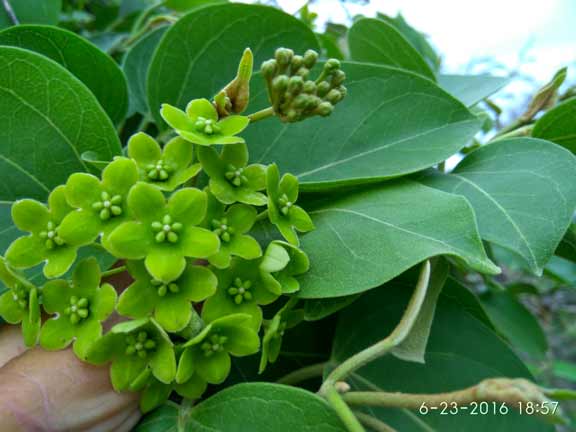
Dregea volubilis

Dregea volubilis, Syn: Wattakaka volubilis. Commonly known as Sneeze Wort, Green wax flower and Akadbel, HirandoliHemajivanti is a large woody climber native to India. Its new leaves have silvery gray soft woolly growth. As the leaves mature the hairy growth becomes less. The flowers grow in a cluster and are absolutely green in colour. These flowers are mildly scented but the scent is exuded only in the evening and at night. The fruits normally are borne as twins. At maturity the pod splits and the seeds having silky, soft tufts like parachutes fly quite far and wide with wind. The climber is supposed to have certain medicinal properties. It is also a food plant for Blue Tiger butterfly larva.


Telosma cordata

Telosma cordata is commonly known as Tonkin jasmine, Pakalana vine and Tonkinese creeper. I have named it as Marble-leaf climber. The leaves are very attractive with dark green, light green and white colours, having interesting marbled effect. The climber has yellow flowers and blooms normally in monsoon. Though the climber has flowers, it is a shy bloomer; it does not bloom profusely. However, its attractive leaves compensate that deficiency. The climber is easily propagated with stem cutting. It can tolerate full sunlight but on terrace or a cemented floor the leaves may get scorched due to reflected heat. It grows best in semi shade. This climber can be grown in pots and can be a trellis mounted in the pot. It is also suitable for arches or pergolas.


Tinospora glabra

Tinospora glabra is an uncultivated woody and large climber. Its common name Amarvel (अमरवेल) is due to its tenacious habit of surviving even in worst conditions. Its other common names are Amrita, Amritvel, Giloyi, Gudachi and Gulvel . Quite often it becomes invasive and climbs on large trees. On a tree it can grow to such an extent that it can smother the tree.  If someone cuts stem of this climber near the ground, the climber sends down wiry aerial roots, which penetrate the ground to get water and nutrients from soil. Thus it becomes very difficult to control it. Birds love the fruits of the climber and through their droppings the seeds are dispersed far and wide.  

Tinospora glabra leaf

Tinospora glabra climber

Tinospora glabra flowers

Tinospora glabra fruit

In spite of it being an invasive, it has many medicinal uses. Its scientific name is Tinospora glabra, Syn: Tinospora cordifolia. Cordifolia means heart-shaped leaves. Cross section of mature stem of this climber reveals cart-wheel like pattern. Tinospora glabra and Tinospora malabarica are two species of this climber. Tinospora glabra has smooth leaves while leaves of Tinospora malabarica are hairy. Besides, T. malabarica is much more invasive than T. glabra. It is reported that T. glabra has better medicinal properties compared to T. malabarica. So if one wants to buy this plant from a nursery, see that the leaves are not hairy. Both these species are drought resistant and are native to India. They belong to Menispermaceae family.

Tinospora malabarica with hairy leaves

Cart-wheel pattern of the cross section of the stem