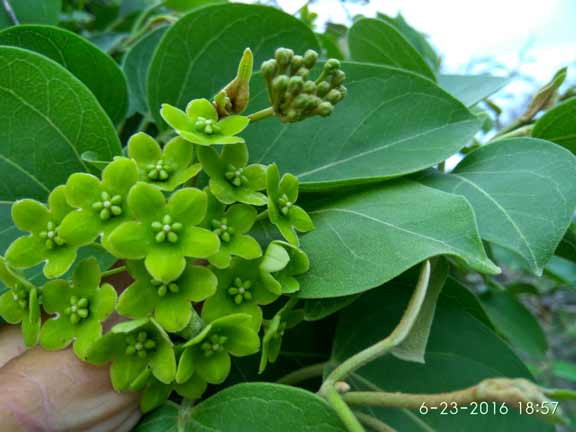
Dregea volubilis, Syn: Wattakaka volubilis. Commonly known as Sneeze Wort, Green wax flower and Akadbel, Hirandoli, Hemajivanti is a large woody climber native to India. Its new leaves have silvery gray soft woolly growth. As the leaves mature the hairy growth becomes less. The flowers grow in a cluster and are absolutely green in colour. These flowers are mildly scented but the scent is exuded only in the evening and at night. The fruits normally are borne as twins. At maturity the pod splits and the seeds having silky, soft tufts like parachutes fly quite far and wide with wind. The climber is supposed to have certain medicinal properties. It is also a food plant for Blue Tiger butterfly larva.
Tuesday, 5 July 2016
Telosma cordata
Telosma cordata is commonly known as Tonkin jasmine, Pakalana vine and Tonkinese creeper. I have named it as Marble-leaf climber. The leaves are very attractive with dark green, light green and white colours, having interesting marbled effect. The climber has yellow flowers and blooms normally in monsoon. Though the climber has flowers, it is a shy bloomer; it does not bloom profusely. However, its attractive leaves compensate that deficiency. The climber is easily propagated with stem cutting. It can tolerate full sunlight but on terrace or a cemented floor the leaves may get scorched due to reflected heat. It grows best in semi shade. This climber can be grown in pots and can be a trellis mounted in the pot. It is also suitable for arches or pergolas.
Tinospora glabra
Tinospora glabra is an uncultivated woody and large climber. Its common name Amarvel
(अमरवेल) is due to its tenacious habit of surviving even
in worst conditions. Its other common names are Amrita, Amritvel, Giloyi, Gudachi and Gulvel . Quite often it becomes invasive and climbs on large trees. On a tree it
can grow to such an extent that it can smother the tree. If someone cuts stem of this climber near the
ground, the climber sends down wiry aerial roots, which penetrate the ground to
get water and nutrients from soil. Thus it becomes very difficult to control
it. Birds love the fruits of the climber and through their droppings the seeds
are dispersed far and wide.
![]() |
| Tinospora glabra leaf |
![]() |
| Tinospora glabra climber |
![]() |
| Tinospora glabra flowers |
![]() |
| Tinospora glabra fruit |
![]() |
| Tinospora malabarica with hairy leaves |
![]() |
| Cart-wheel pattern of the cross section of the stem |
Thursday, 23 June 2016
Cedrela microcarpa (Australian Red Cedar)
Cedrela microcarpa (Syn: Toona ciliata) is a large, fast growing tree, which can grow up to 30 m. tall. Common names are Toon, Toona, Australian Red Cedar, Moulmein cedar, Burma cedar.
It is a deciduous tree with wide spreading branches. The large grown trees have buttress roots which spread quite far from the tree. The bark is rough and brownish grey in colour. The core wood is reddish in colour. Compound leaves of this tree resemble Neem (Azadirachta indica) leaves but are larger. Flowers of Cedrela are white and of tubular shape. Tender fruits of both these trees look similar but Neem fruit is a drupe and the fruit of Cedrela is a capsule. When ripe the Cedrela capsule splits in star shape and tiny, brownish winged seeds are dispersed by wind far and wide. This habit of the tree has made it invasive in some countries. Both Cedrela and Neem tree belong to Meliaceae family. Its origin is supposed to be Australia but now it is naturalized in Tropical Asia, southern China, Himalayas.
Cedrela wood is used for making furniture, carving and inlay work. Its timber is highly valued. However, due to extensive cutting of the trees for its highly valued timber, this tree has diminished in numbers in many countries. The tree is supposed to have certain medicinal uses and is used in Unani and Ayurvedic medicines. Cedrela can be propagated with seeds.
It is a deciduous tree with wide spreading branches. The large grown trees have buttress roots which spread quite far from the tree. The bark is rough and brownish grey in colour. The core wood is reddish in colour. Compound leaves of this tree resemble Neem (Azadirachta indica) leaves but are larger. Flowers of Cedrela are white and of tubular shape. Tender fruits of both these trees look similar but Neem fruit is a drupe and the fruit of Cedrela is a capsule. When ripe the Cedrela capsule splits in star shape and tiny, brownish winged seeds are dispersed by wind far and wide. This habit of the tree has made it invasive in some countries. Both Cedrela and Neem tree belong to Meliaceae family. Its origin is supposed to be Australia but now it is naturalized in Tropical Asia, southern China, Himalayas.
![]() |
| Tender capsules |
![]() |
| Capsules |
![]() |
| Capsules and seeds |
![]() |
| Seed magnified |
![]() |
| https://en.wikipedia.org/wiki/Toona_ciliata#/media/File:Cedrela_toona00.jpg |
Echinopsis multiplex (Easter lily cactus)
Echinopsis multiplex, commonly known as Easter lily cactus is a very sturdy cactus and gives multiples of pups on its side. It tolerates full open sunlight and is not easily affected with wet soil, unlike other cacti. I had this cactus in Mumbai for many years but only after shifting to Pune, it decided to bloom. It is a night blooming cactus. Starts opening as sun sets and by morning it start wilting. Though of very short life, the flower is larger than the plant on which it grows. I have been using following planting medium: 3 parts coarse sand + 1 part cow dung manure or leaf compost + half part of coco peat. It is easily propagated by removal of pups from the mother plant. In fact it is advisable to remove many pups from the mother plant and plant them as separately.
![]() |
| Stages of flower bud growth |
![]() |
| Flowers are larger than the cactus |
Muntingia calabura (Jamaica Cherry, Panama cherry, Singapore cherry)
Muntingia calabura, commonly known as Singapore cherry, Jamaica Cherry, Panama cherry is a small, evergreen tree. Its leaves are slightly hairy and are a bit sticky to touch. The tree is drought resistant and can thrive in poor soil also. In fact it can become invasive due to its habit of sending root suckers and also due to seed dispersal by birds and bats through their droppings. I have observed that Flower pecker birds puncture the fruit near its stalk and suck the juice.
The fruit is a tiny berry with hundreds of minute seeds. The seeds are so tiny that one cannot feel their presence while eating the fruit. The fruit contains juicy pulp which is sweet and with delectable falvour. The skin of the fruit is a bit leathery but is edible. The tree bears flowers and fruit almost all year round. The ripe fruit can be eaten whole and also can be used to make jam and jelly. Flowers and the leaves are supposed to have some medicinal uses. The tree is native to South America but has now been naturalized in many other countries, including India. The tree belongs to Muntingiaceae family.
![]() |
| Hairy leaves with unequal base near leaf stalk |
Thursday, 16 June 2016
Propagating Dendrobium orchids
When a certain stems of Dendrobium become almost leafless, that indicates that the stems would give no more flowers. Such stems are called ‘Exhuasted’. They look ugly on the plant. So it is better to remove them with a sharp secateurs. Instead of discarding such stems it is advisable to put those in an elongated planter in which a thick layer of charcoal and brick pieces is laid.
Keep the brickbats and charcoal moist by spraying water on them. This will encourage the exhausted stems to give new plantlets. Such stems, even if retained on the plant can give new plantlets, but the exhausted stems look bad on a healthy Dendrobium plant. A single exhausted stem can give rise to one to three plantlets. When the plantlets start getting healthy, spongy white roots with active green tips, they can be planted in separate planters. Dendrobium orchids are epiphytic and cannot survive in soil. They grow best in charcoal, brickbats accompanied with a few pieces of coco chips (coconut skin pieces chopped to small size). Here is a video showing the process.
Subscribe to:
Posts (Atom)